
Smart pet feeders have a leading market size, benefiting from pet owners' demand for healthy diets and convenient feeding, but the growth rate has slowed down; smart wearable devices have an outstanding growth rate, reflecting consumers' increased attention to functions such as pet health monitoring, and may integrate more advanced functions in the future.
Amidst the booming pet economy, the smart pet products market is attracting market attention with its unique growth trajectory. According to Zhiyan Consulting , the market size for smart pet products in China has grown from 2.9 billion yuan in 2018 to 5.3 billion yuan in 2024, and this market size is expected to continue to grow. With pet ownership exceeding 22% of households in China, this emerging market, combining emotional consumption with technological attributes, is expected to maintain an average annual compound growth rate of 18.7% between 2018 and 2025 .
1. From emotional companionship to smart pet care
China's pet economy is currently undergoing a transition from quantitative change to qualitative change. According to the "2025 China Pet Industry White Paper," China's urban pet (dog and cat) consumer market is projected to exceed 300 billion yuan in 2024, with smart pet products accounting for 18% of this total , an increase of nearly 12 percentage points from 2018. This growth is driven by the escalating pet consumption driven by the post-90s and post-00s generation becoming the primary force in pet ownership. These individuals view their pets as "family members," are willing to pay a premium for an improved quality of life for their furry companions, and are pursuing more scientific and convenient pet care methods.

The explosive growth of smart pet products in recent years is essentially the product of the collision of technological advancement and emotional needs. IoT technology enables remote control of devices, artificial intelligence algorithms analyze pet behavioral data, and big data analytics help brands accurately understand user pain points. For example, smart heating and cooling pads launched by smart pet product manufacturers use temperature sensors to automatically adjust to the optimal temperature range for pets. Smart feeders equipped with weighing systems accurately control the weight of each meal and generate dietary reports. These innovative products not only address the pain points of traditional pet care but also reshape the way people interact with their pets .
2. Market Map: Five Core Categories
1. Smart feeding equipment
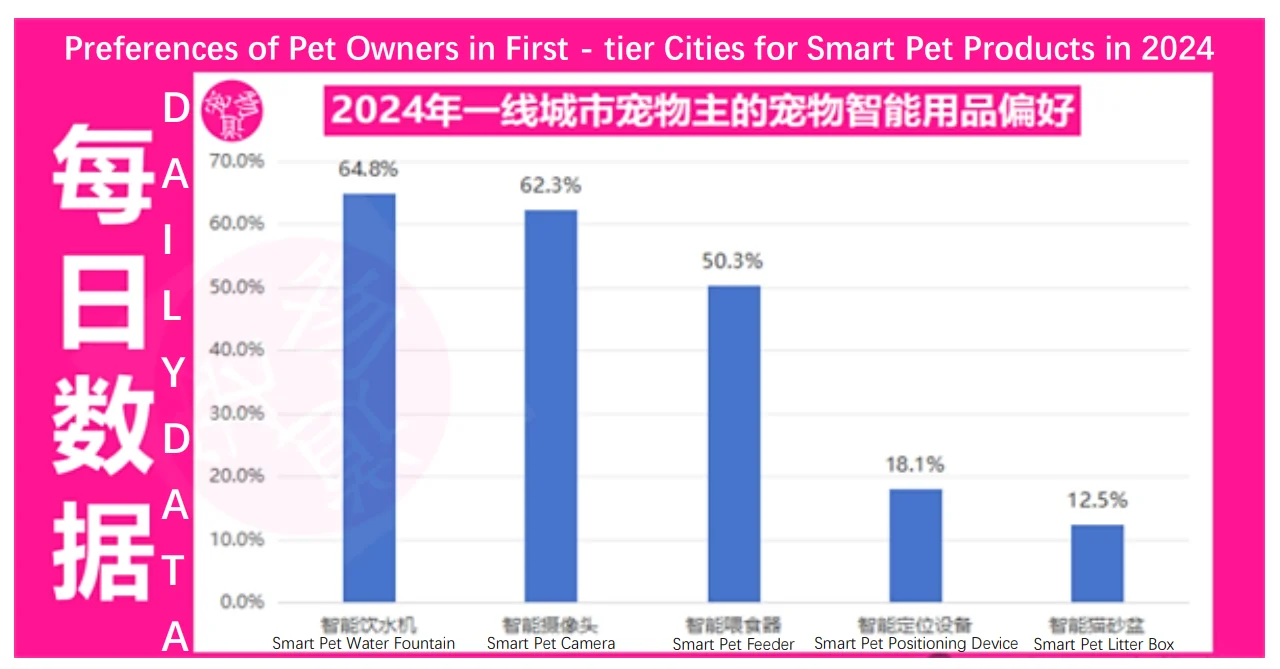
Data shows that by 2024, smart feeding devices will account for 53% of the total smart pet product market , far exceeding smart wearables and smart pet-entertainment devices. As essential products , smart feeders and smart water dispensers account for half of the market share. Among pet owners in first-tier cities, a significant 64.8% prefer smart water dispensers . Smart pet feeders on the market now feature app-based remote control and food level monitoring, precisely addressing the needs of office workers for regular, quantitative feeding . However, the growth rate of this category has slowed to an average annual 12%, as the market shifts from functional competition to optimized details such as material safety, food jam prevention , and multi-pet feeding .
2. Smart monitoring equipment
The smart monitoring devices we're referring to here primarily refer to smart cameras , often called the "second pair of eyes" for Generation Z pet owners. They're second only to smart water dispensers in popularity. Pet cameras on the market are equipped with AI behavior recognition algorithms to distinguish between normal pet activity and unusual agitation, automatically sending alerts when they detect continuous barking or prolonged periods of inactivity. This category is expanding beyond simple monitoring to include health management , with some high-end products already integrating temperature monitoring.
3. Smart wearable devices
Smart pet wearables are also developing rapidly. Despite their current low market share, they are leading the industry with an average annual growth rate of 35% . Some brands of smart pet collars use a three-axis accelerometer to monitor a pet's activity level in real time, generating personalized health recommendations based on the pet's breed and age. In the future, this category will evolve into medical-grade devices , integrating with veterinary diagnostic systems to provide disease warnings, for example.
4. Smart cleaning equipment
Smart cat litter boxes , fully automatic litter boxes , and flush cat toilets are all star products in the field of smart pet cleaning devices, a market share that major manufacturers are vying for. Smart litter boxes use weight sensors to identify different pets, automatically clean themselves, and count urinations. Their urine bolus monitoring function can help detect urinary tract diseases early. However, this category still faces user experience issues such as litter jamming and poor deodorization .
5. Smart interactive devices
Intelligent companion pet robots possess both market foundation and growth momentum, expanding beyond their "toy" niche. These robots utilize SLAM algorithms for autonomous obstacle avoidance and are equipped with laser pointers and sound generators for interaction with pets. The behavioral data they collect can help owners understand their pets' emotional states. Although their current penetration rate is less than 5%, this category represents the future direction of "affective computing technology . "
3. Competition landscape of the pet smart products market
The smart pet products industry is a diverse field. Data shows that from 2014 to 2023, the number of registered pet product-related companies in China surged from 13,700 to 140,000 , demonstrating a significant growth trend. Overall, these players can be broadly categorized into three main groups: specialized players, transition players , and cross-industry players.
Professional players represented by Xiaopei , according to unofficial data, occupy 23% of the market share with its full product category layout, especially its "hardware + content + service" ecological model is worthy of attention; through cooperation with pet hospital chain brands, Xiaopei has also built a closed loop from equipment data collection to hospital analysis and diagnosis, and then to recommendation of customized products.
Transformation players represented by Pidan , relying on their advantages in the cat litter supply chain, have launched smart cat litter boxes , using the "high cost-effectiveness + industrial design" strategy to seize the mid-range market.
Cross-border players represented by Xiaomi . At present, Xiaomi's ecological chain companies have deployed a full range of products such as feeders, cameras, collars, etc. Its "explosive product strategy + channel advantages" has enabled some single products to have a market share of more than 30%, firmly ranking first on the corresponding list.
4. The boundaries of the industry are constantly being expanded
Despite the promising market prospects for smart pet products, the industry still faces significant challenges. First, product homogeneity is severe , with some categories locked in price wars. Second, privacy and security are controversial , with no clear regulations governing the ownership of pet behavior data collected by smart devices. Third, the elderly pet market is underdeveloped , with a shortage of health monitoring devices for pets aged 7-10 years and older.
In the future, the smart pet product market will see breakthroughs in technology integration, healthcare, and application-specific segments, transforming from a single hardware offering to a service ecosystem . The widespread adoption of 5G and AI technologies will drive interoperability between devices. For example, smart feeders and scales can coordinate feeding amounts, creating truly personalized feeding plans . Advances in flexible electronics may also lead to smart collars that can more accurately monitor a pet's heart rate and blood pressure. The integration of smart pet products and healthcare has become a new growth point. Leading companies are already experimenting with integrating SOS buttons into smart devices, automatically contacting a contracted veterinarian when a pet suddenly becomes ill. Customized products for different pet breeds and specific pet-raising scenarios will emerge. For example, a smart cooling mat designed specifically for short- nosed dogs integrates temperature and humidity sensors and a miniature fan.
Opportunities outweigh challenges. It's predicted that by 2028, segments like smart pet medical devices and elderly pet care products are expected to grow at rates exceeding 50%, further increasing market penetration. For pet owners, smart products are not only changing their pets' lives but also reshaping the emotional connection between humans and pets . For businesses, deepening technological barriers, building closed-loop ecosystems, and accurately understanding niche needs will be key to future success.
https://www.y-crystaled.net/understanding-my-country-s-smart-pet-products-market-in-one-article.html